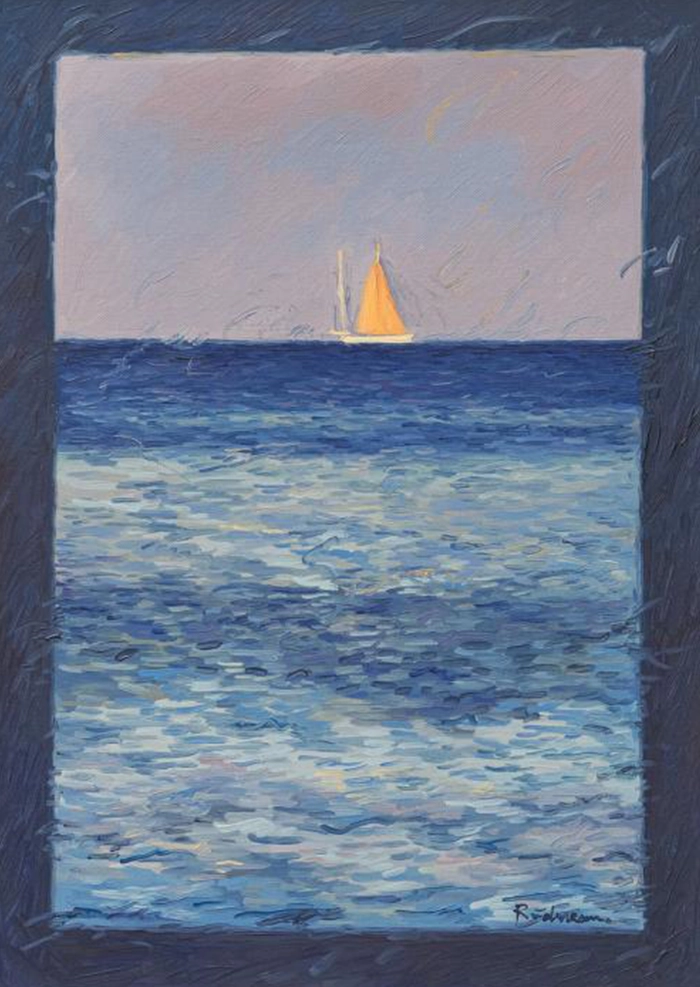
WIN Gallery: There are works that impose themselves gradually and others that create an immediate connection. How did your encounter with this work unfold, before the acquisition?
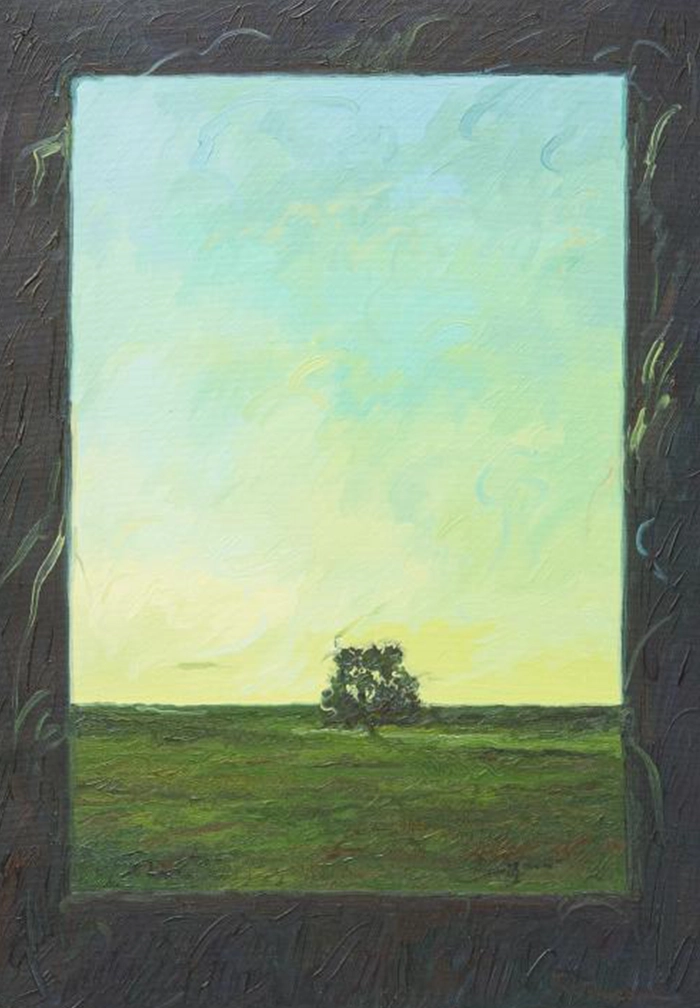
DG: It was the last work in the guided tour at the time of the visit. It fit perfectly within the budget line, but also within what I was looking for. It was the work that conveyed that something necessary for an immediate attraction, and I did not hesitate any longer.
WIN Gallery: From your perspective as a physiotherapist, do you feel that the work dialogues, in a way, with ideas such as inner rhythm, breathing, or bodily balance?
DG: It makes you breathe calmly. The landscape illustrated through the window and that evening green, but also the melancholic nuance, make you breathe deeply and calmly.
WIN Gallery: After a work enters a personal space, the relationship with it transforms. Where is the work today, and how does it integrate into your day-to-day life?
DG: The work has remained in view, leaning against the wall in front of the sofa in the living room, where I spend most of my relaxation time at home. It is in a position where it now seems that I am about to find it a place of its own, but until then I want to look at it some more.
WIN Gallery: In therapeutic practice, healing is never only physical. Do you believe that art can play a real role in processes of emotional self-regulation or recovery, even outside an explicit therapeutic framework?
DG: I believe that art itself represents a form of therapy. You look at it and it passes, or you gather yourself so that you can move forward.
WIN Gallery: The first acquisition is often a symbolic threshold. Did this experience change the way you view Romanian contemporary art and open your interest toward other names or directions?
DG: After the first acquisition, the desire to experience the same emotion grows, but in fact it always becomes something else. From contemporary art, I can say that I have noticed Felix Aftene, Sorin Ilfoneanu, Ștefan Câlția, and a few other artists who are currently in trend, but I always want to discover an emotion, a state that conveys something to me. This tells me about the artist that they work with passion and put their soul into their art, and here the size of the artist does not matter, but the state displayed on the canvas.
WIN Gallery: Over time, some works remain relevant, others fade. How would you define a work of art that “functions” in the long term for you?
DG: I believe that the work remains directly connected to the artist. I consider that it depends to the greatest extent on the artist’s professional path, or on how much they maintain or change their style.